The AI Battle Between CMS Platforms and Plugins: Who Will Control the Future of Content Management?
 20 min read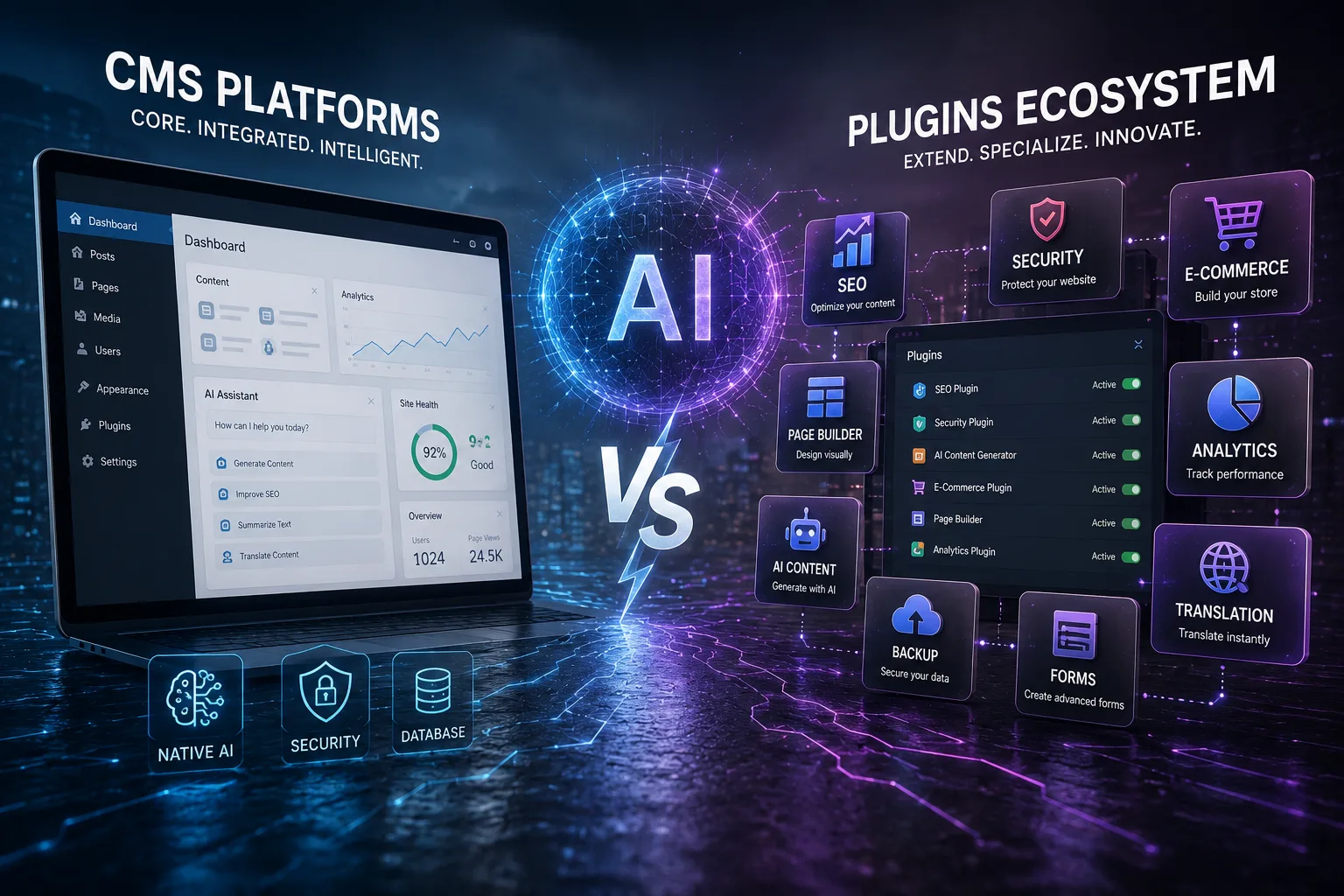
For more than two decades, content management systems have formed one of the most important foundations of the modern web. Businesses, publishers, online stores, universities, governments, independent creators, and global organizations have relied on CMS platforms to publish and manage digital information without rebuilding their websites whenever content changes. Around these systems, another enormous industry has developed: plugins and extensions. Instead of attempting to include every possible capability inside the CMS itself, platforms created ecosystems in which independent developers could provide specialized functionality for SEO, security, e-commerce, analytics, forms, translation, caching, design, editorial workflows, backups, and countless other requirements. This separation created one of the most successful software models on the internet, allowing a relatively stable core platform to support websites with dramatically different purposes.
Artificial intelligence is beginning to challenge that relationship because AI does not behave like a traditional website feature. An SEO plugin performs SEO tasks, a security plugin protects the website, and a translation plugin translates content, but a sufficiently capable AI system can participate in all three activities while also helping to write articles, generate images, create metadata, recommend internal links, analyze analytics, assist developers, classify media, answer administrative questions, and automate workflows. Intelligence therefore cuts horizontally across categories that were historically separated into different products. As CMS platforms begin integrating AI directly into their architecture and plugin developers simultaneously add AI to their products, both sides increasingly find themselves competing for the same territory.
The important question is no longer whether artificial intelligence will become part of content management. That transition has already begun. The more consequential question is where that intelligence should exist and who should control it. Should every plugin maintain its own connection to AI models and provide intelligence independently, or should the CMS become the central intelligence layer of the website? The answer could determine not only how websites are managed but also how the multi-billion-dollar ecosystem surrounding content management software evolves during the next decade.
Why Artificial Intelligence Changes the Traditional CMS Model
The traditional relationship between a CMS and its plugins was based on specialization. A content management system concentrated on fundamental responsibilities such as storing content, managing users, controlling permissions, handling media, organizing taxonomies, providing APIs, and publishing pages. When a website required something beyond those responsibilities, an extension could add it. This architecture allowed developers to keep the core relatively manageable while giving website owners enormous flexibility. It also created healthy competition because multiple companies could build different solutions for the same problem, allowing customers to choose according to features, price, performance, or technical requirements.
Over time, however, plugins became considerably more ambitious. Some page builders effectively created complete design environments inside the CMS. E-commerce extensions introduced their own product models, payment systems, customer databases, inventory management, and reporting interfaces. SEO plugins became sophisticated analytical platforms, while security extensions developed firewalls, malware scanners, authentication systems, and external threat-intelligence networks. Even before generative AI appeared, the boundary between a CMS and the software installed on top of it was becoming increasingly difficult to define. In many installations, users spent more time interacting with plugin interfaces than with the original CMS itself.
Artificial intelligence accelerates this convergence because it is inherently general-purpose. Consider the process of publishing a single article. AI can research ideas, propose an outline, generate a draft, improve its language, suggest a headline, create a meta description, recommend internal links, produce alternative text for images, translate the article, generate a featured image, create social media posts, classify the content, and analyze whether it complies with editorial guidelines. In a traditional CMS architecture, these responsibilities might belong to six or seven separate plugins. An integrated AI system can potentially perform all of them from a single context.
This creates an uncomfortable situation for both CMS vendors and plugin developers. If the CMS can provide high-quality AI functionality natively, users may question why they need multiple separate AI extensions. At the same time, if specialized plugins deliver significantly better intelligence in their respective fields, a generic CMS assistant may feel shallow and insufficient. The emerging competition is therefore not simply about adding an AI button to an existing interface. It is about determining which layer of the website should understand its data, coordinate intelligent operations, and ultimately become the primary interface between administrators and increasingly complex digital systems.
The Greatest Advantage of Native CMS AI Is Context
Artificial intelligence becomes substantially more useful when it understands the environment in which it is operating. A general-purpose language model can write an article about almost any subject, but an intelligent system integrated deeply into a CMS can potentially know what the organization publishes, how its content is structured, which categories exist, which articles have already been written, which authors contribute to the site, what tone the brand uses, what languages are supported, which pages receive the most traffic, and which users have permission to perform particular actions. That context transforms AI from a generic content generator into something closer to an intelligent participant in website management.
Internal linking illustrates this advantage clearly. A standalone writing assistant might recognize that a paragraph contains a concept that should link to another resource, but without detailed knowledge of the website it cannot reliably know which existing page is the best destination. A CMS-native AI system could inspect the complete content repository, understand relationships between articles and entities, identify authoritative pages, detect orphaned content, and recommend specific links based on the site’s actual architecture. The same contextual advantage could improve related-content recommendations, taxonomy assignment, content updates, translation, metadata creation, and editorial planning.
Context becomes even more powerful when AI is connected to structured data rather than simply reading rendered pages. A CMS understands that one record is an article, another is an author, another is a product, and another may represent a company, event, location, or customer. It understands relationships between these entities and can potentially expose them to AI in a controlled way. Instead of treating the website as a collection of unrelated text documents, an intelligent CMS can reason over a structured digital environment. This could become one of the defining differences between generic AI tools and AI systems designed specifically for content management.
Native integration also provides continuity. A plugin may understand the specific information required for its own function but remain unaware of decisions being made elsewhere. The CMS sits at the center of the environment and can potentially maintain shared instructions, brand guidelines, terminology, permissions, and historical context that every AI capability can use. If implemented correctly, this eliminates the strange situation in which several AI plugins installed on the same website behave as though they are working for completely different organizations.
Why Specialized AI Plugins Still Have a Powerful Position
The contextual advantage of a CMS does not mean plugin developers are destined to lose. Specialized extensions possess expertise, infrastructure, and proprietary information that a general content management platform may find extremely difficult to reproduce. A company that has spent years developing search optimization technology, for example, may understand keyword relationships, ranking behavior, technical crawling, structured data, competitor analysis, and search intent at a depth that a general-purpose CMS team cannot realistically match. Adding AI to that specialized knowledge can create a much more sophisticated SEO system than a generic assistant capable of generating titles and meta descriptions.
Security provides an even stronger example. A professional security platform may analyze attack patterns across enormous numbers of websites, maintain continuously updated malware signatures, operate external firewalls, monitor suspicious IP addresses, and develop specialized detection algorithms. Artificial intelligence can enhance those capabilities by identifying unusual behavior, prioritizing vulnerabilities, explaining complex threats, and helping administrators respond to incidents. A native CMS assistant may be able to inspect configuration or recommend basic security improvements, but reproducing a global threat-intelligence network is an entirely different problem.
The same principle applies to e-commerce, analytics, translation, accessibility, legal compliance, and many other specialized areas. AI does not automatically erase domain expertise; in many cases it makes domain expertise more valuable because specialized companies can combine general model capabilities with proprietary data and years of accumulated knowledge. The strongest plugin companies are therefore unlikely to compete with CMS platforms simply by offering another generic chatbot. They will use AI to deepen capabilities that would be difficult for the core platform to build economically or technically.
This suggests that the real disruption will occur among plugins whose value consists primarily of simple functions that general AI can reproduce easily. Extensions that exist only to generate short descriptions, rewrite text, produce basic metadata, or perform straightforward classification may find themselves under increasing pressure as those functions become standard CMS capabilities. Specialized products supported by unique infrastructure, data, or expertise have a much stronger defensive position. AI will not eliminate the plugin ecosystem, but it may force that ecosystem to become considerably more sophisticated.
The Content Editor Is Becoming the First Major Battlefield
The content editor is one of the most strategically important areas in this competition because it is where writers, marketers, editors, and administrators spend a large portion of their time. Historically, editors were relatively passive interfaces. They allowed users to enter text, insert media, create links, adjust formatting, assign categories, and publish content. Plugins could add additional controls around that workflow, but the editor itself primarily waited for human input. Artificial intelligence changes this relationship by allowing the editing environment to participate actively in the creative process.
An AI-native editor can help generate outlines, continue paragraphs, rewrite sections, change tone, simplify complex language, summarize material, propose titles, generate FAQs, create excerpts, recommend links, produce image descriptions, translate content, and check whether an article follows predefined editorial standards. More importantly, these capabilities can work together rather than existing as isolated buttons. An intelligent editor could understand the objective of an article from the beginning and assist throughout its complete lifecycle, preserving context as the content develops.
If these capabilities become native, the market for basic AI writing extensions could shrink dramatically. Users generally prefer a coherent experience over switching between multiple panels that each contain their own prompts, credits, settings, and model choices. CMS vendors understand this and have a strong incentive to make their editors the natural home for content-related AI. Whoever owns the intelligent editing experience also gains influence over adjacent activities such as SEO, media generation, translation, and publishing automation.
Plugin developers will therefore need to differentiate themselves beyond basic generation. They might provide specialized editorial workflows, advanced research capabilities, proprietary fact-checking systems, industry-specific terminology, stronger model orchestration, or sophisticated optimization based on external datasets. The battle will not be decided by which product can generate a paragraph. That capability is rapidly becoming ordinary. The valuable question is which system understands why the paragraph is being written, how it relates to the rest of the website, and what should happen after it is created.
SEO Shows How Quickly Native AI Can Absorb Plugin Territory
SEO is particularly exposed to this transformation because many optimization tasks are closely connected to content that the CMS already controls. Traditional SEO extensions became essential because content management platforms provided limited support for metadata, structured data, sitemaps, redirects, canonical URLs, readability analysis, keyword optimization, and other search requirements. Over time, sophisticated SEO plugins became almost mandatory components of many professional website installations.
AI allows CMS platforms to absorb part of that functionality naturally. While an editor is writing an article, the system can analyze heading hierarchy, suggest titles and descriptions, identify related pages for internal linking, recommend alternative image text, detect topic gaps, propose structured data, and evaluate whether the article sufficiently addresses its intended subject. Because the CMS has direct access to the site’s content and structure, some recommendations may be more contextually accurate than those generated by an extension examining the page from the outside.
Dedicated SEO platforms still possess substantial advantages. Serious search optimization involves ranking data, backlink analysis, competitive intelligence, historical trends, large-scale crawling, keyword databases, and information that does not naturally exist inside a CMS. Native AI is unlikely to replace this infrastructure. What it can do is absorb the basic and intermediate optimization features that once justified installing a plugin for many ordinary users. This pushes specialist SEO products toward more advanced strategic territory.
The result is likely to resemble what has happened in many software markets: features that were once premium eventually become part of the platform, while specialist products survive by solving harder problems. AI accelerates this cycle because it allows platforms to implement sophisticated-looking capabilities much faster than before. Plugin developers can no longer assume that a successful feature will remain outside the CMS indefinitely.
Plugin Overload Could Become a Major Argument for Native AI
Extensibility gives CMS platforms enormous flexibility, but excessive reliance on plugins creates a well-known operational problem. Mature websites can accumulate dozens of extensions over several years. Each may introduce PHP or JavaScript code, database tables, scheduled processes, stylesheets, API calls, dependencies, configuration screens, and its own update cycle. Even when individual plugins are well engineered, the combined system can become difficult to understand and maintain.
Artificial intelligence can make this fragmentation worse if every existing plugin adds its own AI subsystem. A website could easily end up with separate AI assistants for content, SEO, translation, security, e-commerce, analytics, media, and design. Each might require a separate subscription, API configuration, privacy policy, prompt system, usage quota, and external model connection. Administrators could find themselves managing an ecosystem of intelligent tools that have almost no awareness of one another.
A centralized CMS intelligence layer offers an appealing alternative. One controlled AI architecture could provide common capabilities such as content generation, summarization, classification, translation assistance, image metadata, administrative search, and contextual recommendations. Specialized plugins could then request intelligence from that shared layer instead of independently building the same infrastructure. This could reduce duplicated functionality while making costs, permissions, and data flows easier to understand.
For website owners, consolidation could become one of the strongest arguments for native AI. The attraction is not merely having another intelligent feature; it is reducing complexity. A system that replaces five disconnected AI extensions with one coherent intelligence layer may provide greater practical value even if some individual features are less sophisticated than specialized alternatives.
The Battle Is Also About Money, Data, and Customer Ownership
Behind the technical debate lies a significant economic conflict. Plugin ecosystems have created successful recurring-revenue businesses because website owners routinely pay annual subscriptions for premium extensions. Generative AI introduces another recurring resource: computation. Every generated article, translated page, analyzed document, image, or intelligent conversation consumes model capacity, and that usage must eventually be paid for through subscriptions, credits, infrastructure fees, or usage-based pricing.
CMS providers have a strong incentive to capture this new revenue stream. A platform could offer a unified AI subscription that works across writing, design, media, translation, SEO, and administration. Instead of purchasing separate AI plans from multiple plugin companies, customers might buy a pool of credits directly from the CMS provider. If the platform also controls the editor and administrative interface, it can make its own AI service the easiest default choice.
Plugin companies have equally strong reasons to resist that centralization. Maintaining an independent AI service gives them control over pricing, model selection, customer relationships, proprietary workflows, and valuable usage data. Some may build their own model orchestration systems or combine several AI providers to deliver specialized results. Others may eventually choose to use a CMS-provided AI infrastructure while selling higher-level capabilities on top of it.
This economic tension will influence technical architecture. Decisions presented as questions of convenience or integration may also determine who receives subscription revenue and who controls customer data. The company that owns the intelligence layer could become one of the most powerful participants in the entire CMS ecosystem.
Privacy and Security Could Decide Which Architecture Users Trust
As AI becomes integrated more deeply into website administration, privacy and security become central concerns rather than secondary technical details. A site using several AI plugins may send information to multiple external providers. Article drafts could be transmitted to one service, customer information to another, media to a third, and analytics to yet another. Administrators may have difficulty determining exactly which information leaves the website, how long it is retained, whether it is used for model training, and which jurisdictions are involved.
Centralized AI infrastructure could make governance considerably clearer. The CMS could define which model providers are approved, which categories of data may be transmitted, which user roles can invoke AI operations, how prompts and responses are logged, and whether sensitive information must be anonymized before processing. Organizations could potentially select private models or self-hosted infrastructure for confidential workloads while allowing public content to use commercial APIs. A consistent governance layer would be much easier to audit than a collection of unrelated plugin integrations.
Security becomes even more critical when AI evolves from providing suggestions to performing actions. An assistant that recommends a headline creates relatively little operational risk. An AI agent capable of changing templates, creating users, installing extensions, modifying database records, publishing content, handling orders, or changing security settings possesses significant power. Such actions must operate within strict permission boundaries, require authorization where appropriate, generate audit logs, and ideally support rollback.
CMS platforms are well positioned to enforce these controls because they already manage users, roles, permissions, content states, and administrative actions. Plugins can also build secure AI agents, but the ecosystem will need consistent standards. The future of intelligent content management depends not only on what AI is capable of doing but also on proving that it cannot silently exceed the authority it has been given.
The Most Likely Future Is a Shared AI Layer
The long-term outcome may not be a simple victory for CMS platforms or plugins. A more sustainable architecture could emerge in which the CMS provides a standardized intelligence layer and specialized extensions build on top of it. The platform would manage common responsibilities such as model connections, credentials, permissions, usage limits, logging, website context, privacy policies, and perhaps a standardized mechanism for invoking AI capabilities.
Plugins could then contribute domain expertise without recreating the entire AI stack. An SEO extension might use the shared intelligence layer while providing proprietary search data and optimization logic. A security plugin could combine common models with its threat-intelligence network. A translation service could access approved website context without maintaining a completely separate representation of the content repository. Administrators would gain centralized control while developers would retain the ability to innovate independently.
Such an architecture could also reduce dependence on individual model providers. A CMS might allow organizations to choose between different commercial APIs, private enterprise models, open-source systems, or locally hosted models. Plugins would request capabilities through the platform rather than hard-coding themselves to a particular provider. Switching the underlying AI infrastructure would therefore become possible without replacing every intelligent extension installed on the website.
This model closely resembles an operating system. The CMS provides common infrastructure, permissions, resources, and context, while extensions provide specialized applications. Artificial intelligence becomes a platform capability rather than a feature belonging exclusively to either the core or individual plugins.
AI Agents May Ultimately Change How Users Interact With Plugins
The arrival of AI agents could produce an even deeper change. Today, administrators interact directly with plugins by opening their settings pages, configuring options, reading reports, and manually initiating actions. An agent-based CMS could allow users to express goals instead. An administrator might ask the system to identify outdated articles, find broken internal links, investigate a sudden traffic decline, prepare a security report, optimize oversized images, or locate products with incomplete information.
The CMS agent could coordinate several specialized tools behind the scenes. It might call an SEO plugin to retrieve search information, use a media extension to optimize images, ask a security service for threat data, and then combine those results into one coherent response. The plugins would remain essential, but users might interact with them less directly. Their functionality would increasingly become capabilities available to the broader intelligence layer.
This would fundamentally change competition inside plugin marketplaces. Interface design and the number of visible features may become less important than the quality of APIs, machine-readable capabilities, reliability, proprietary data, and the ability to cooperate with intelligent orchestration systems. Plugins designed primarily for human interaction may need to evolve into services that both humans and AI agents can operate.
The shift could be as important as the transition from desktop software to web APIs. Plugins would stop being isolated destinations inside the administration panel and become components of an intelligent ecosystem capable of collaborating to achieve higher-level objectives.
Conclusion: CMS Platforms and Plugins Are Entering a New Relationship
Artificial intelligence is not simply adding another category to the CMS plugin marketplace. It is forcing the entire content management industry to reconsider where functionality belongs and how different parts of a website should communicate. Because AI can participate simultaneously in writing, SEO, design, translation, media management, security, analytics, development, and administration, it naturally crosses boundaries that defined the traditional relationship between CMS platforms and extensions.
CMS providers have major advantages. They control the content repository, understand users and permissions, coordinate website structure, and own the primary administrative experience. This makes them natural candidates to provide a shared intelligence layer capable of understanding the website as a complete system. Plugin developers, however, possess specialization, proprietary data, external infrastructure, and domain expertise that general-purpose platforms cannot easily reproduce. The strongest extensions will use AI not merely to generate content but to make their specialized knowledge significantly more powerful.
The likely future is therefore neither a CMS without plugins nor a website filled with dozens of disconnected AI assistants. A more mature model is beginning to emerge in which the CMS acts as an intelligent operating environment while specialized extensions provide advanced capabilities through controlled interfaces. Common AI functionality can become native, while plugins concentrate on problems where expertise, infrastructure, and proprietary information create genuine differentiation.
This transition will also introduce new responsibilities. Model access must be governed, sensitive data protected, permissions enforced, autonomous actions audited, and generated outputs tested. The ability to automate more of a website does not reduce the importance of architecture and security; it makes both more important. An intelligent CMS that can coordinate powerful extensions will require stronger boundaries than the relatively passive content management systems that preceded it.
The battle between CMS platforms and plugins may therefore end in something more interesting than one side defeating the other. Artificial intelligence could force both sides to evolve into parts of a new architecture. The CMS becomes the context-aware intelligence and orchestration layer of the website, while plugins become specialized services capable of contributing knowledge and actions to that intelligence.
In that future, content management systems will no longer exist merely to store and publish information. They will understand the digital environments they manage, assist the people operating them, coordinate specialized services, and increasingly participate in decisions that previously required administrators to move manually between dozens of separate tools.
The plugin will not disappear. The CMS will not absorb everything. But the boundary between them is being redrawn, and artificial intelligence is holding the pen.
Also credited