
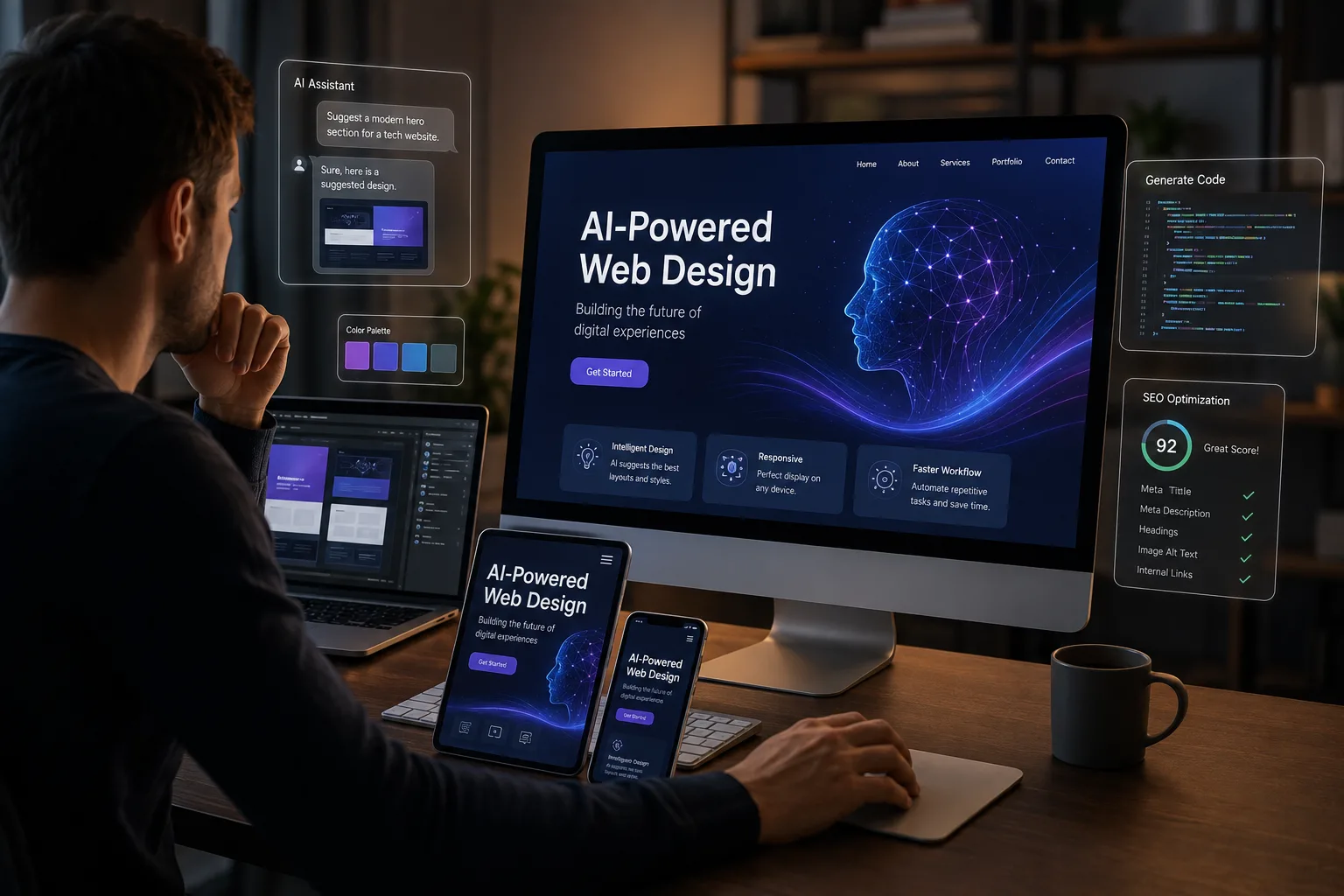
Artificial intelligence is changing the technology industry at a pace few previous innovations have matched, and web design is becoming one of the clearest examples of that transformation. For decades, creating a professional website required a relatively predictable combination of specialists: designers established the visual language, UX professionals planned user journeys, developers translated interfaces into code, content teams produced copy and imagery, and quality assurance teams tested the finished product. Artificial intelligence is beginning to participate in almost every part of this workflow. It can help research competitors, generate design concepts, create interfaces, write code, produce content, analyze user behavior, detect accessibility problems, optimize pages for search engines, and even suggest improvements after a website has been launched.
The significance of this shift goes far beyond making websites faster or cheaper to produce. AI is gradually changing what it means to design a website in the first place. Instead of manually defining every element of a static interface, designers are beginning to create systems in which content, components, interactions, and sometimes entire experiences can adapt intelligently. Developers can describe functionality in natural language and receive working implementations. Businesses can create personalized experiences at a scale that would previously have required enormous teams and budgets. At the same time, this new capability introduces serious questions about originality, quality, accessibility, security, maintainability, and the future role of professional designers.
The next generation of web design will therefore not simply be traditional design performed more quickly with AI tools. It is developing into a fundamentally different discipline in which human creativity, machine intelligence, design systems, data, and software architecture increasingly operate together.
From Traditional Web Design to AI-Assisted Creation
Traditional web design has always involved a considerable amount of manual exploration. Before a designer creates the final interface, there may be competitor research, mood boards, sketches, wireframes, typography experiments, color studies, user-flow diagrams, and several generations of high-fidelity mockups. Even experienced designers can spend days establishing the right visual direction before development begins. Once the interface is approved, developers must interpret those designs and reproduce them accurately in code, often discovering technical limitations or responsive issues that require another round of communication with the design team.
Artificial intelligence compresses many of these early stages. A designer can describe a company, its audience, objectives, brand personality, content structure, and desired visual direction and use AI to rapidly explore multiple approaches. Instead of manually constructing every initial wireframe, AI can suggest information architectures and page structures. Instead of beginning typography exploration from an empty canvas, designers can generate combinations based on the characteristics of the brand. Even early content can be generated specifically for the interface rather than relying on generic placeholder text that bears little resemblance to the final website.
This acceleration does not necessarily reduce the importance of designers. It changes where their time is spent. When producing ten initial concepts becomes dramatically easier, the challenge moves from production to evaluation. Someone still has to recognize which concept communicates the brand correctly, which hierarchy makes sense to users, which interaction creates unnecessary friction, and which attractive-looking design will become difficult to maintain after launch. AI makes generating possibilities inexpensive; professional judgment determines whether those possibilities are valuable.
Natural Language Is Becoming a New Design Interface
For most of the history of digital design, people interacted with design software visually. They created frames, dragged objects, adjusted grids, selected fonts, changed colors, configured constraints, and manipulated components. AI introduces an additional interface between human intention and digital production: natural language. Increasingly, designers and developers can describe what they want rather than constructing every detail manually.
This change may appear simple, but it has major implications. A sophisticated instruction can contain far more than a request for a particular visual style. It can define the purpose of a page, target audience, content hierarchy, design-system rules, accessibility expectations, responsive behavior, animation philosophy, technical restrictions, performance targets, and even conditions that should never occur. AI can then interpret those requirements and generate an initial solution. The process begins to resemble creative direction combined with systems engineering.
As a result, the ability to communicate design intent precisely is becoming an important professional skill. Asking AI to “create a modern technology website” will usually produce something generic because the instruction itself contains almost no meaningful creative direction. Defining the brand personality, desired emotional response, visual references, prohibited patterns, spacing philosophy, typography characteristics, responsive priorities, and interaction principles creates a much stronger foundation. In the AI era, better instructions do not replace design knowledge; they expose how much design knowledge the person giving the instructions actually possesses.
AI Is Redefining the Relationship Between Designers and Developers
One of the oldest challenges in web production is the gap between design and development. A visually impressive interface can become technically expensive or difficult to implement, while a technically efficient implementation may lose details that made the original design distinctive. Teams have developed design systems, component libraries, prototyping tools, and better handoff processes to reduce this gap, but communication between visual intention and executable code has remained a major part of web development.
AI is beginning to narrow that distance. Modern coding assistants can generate HTML, CSS, JavaScript, framework components, database interactions, API integrations, tests, and documentation from natural-language requirements. They can also analyze existing codebases and modify components while attempting to respect established patterns. For designers with technical knowledge, this makes it possible to move much further into implementation. For developers, it reduces the repetitive work involved in translating well-defined interface requirements into code.
However, the ability to generate functioning code should not be confused with the ability to engineer a reliable commercial product. AI can create code that looks correct while containing architectural weaknesses, unnecessary dependencies, accessibility problems, security vulnerabilities, performance issues, or subtle responsive failures. Code generation therefore increases the importance of architecture, testing, review, and technical governance. The question is no longer simply whether AI can build a page. It is whether the generated implementation can survive years of updates, traffic, integrations, security requirements, changing browsers, new devices, and contributions from multiple developers.
Responsive Design Is Entering a More Intelligent Era
Responsive design transformed the web when mobile devices became a primary way of accessing the internet. Designers could no longer create a fixed desktop page and assume that users would experience it under similar conditions. Interfaces had to adapt to smartphones, tablets, laptops, large desktop displays, different orientations, pixel densities, input methods, and browser behaviors. Yet even today, many responsive websites remain based primarily on a limited number of predefined breakpoints.
AI can make responsive design considerably more sophisticated. Intelligent systems can analyze not only available width but also the relative importance of content, interaction complexity, text length, device capabilities, and the context in which components are being displayed. A dense desktop dashboard, for example, should not simply become a smaller dashboard on a phone. Navigation may need to change, secondary information may need to collapse, controls may require larger touch targets, tables may need alternative representations, and the entire hierarchy of the experience may need to be reconsidered.
AI-assisted development can also make comprehensive responsive testing more practical. Instead of manually inspecting a handful of common resolutions, automated systems can evaluate interfaces across a much wider range of viewport sizes and identify overflow, clipping, inconsistent spacing, unreadable typography, broken grids, or interaction problems. This matters because modern responsiveness extends far beyond “desktop, tablet, and mobile.” Professional websites must perform reliably across high-resolution monitors, compact laptops, Retina displays, Android devices, iPhones, tablets, different browser engines, and accessibility settings. AI can help teams manage this complexity, but only when responsiveness is treated as a design requirement rather than an automatic side effect of generated code.
Generative UI Could Change the Meaning of a Web Page
Perhaps the most radical long-term change is the emergence of generative user interfaces. Most websites today are constructed from predetermined templates. A designer establishes the layout, developers build it, and a content management system replaces specific pieces of content while the underlying presentation remains relatively stable. Two visitors to the same page usually see almost the same structure even when their needs are completely different.
AI makes a more adaptive model possible. Imagine a technology company serving developers, investors, potential employees, and enterprise buyers. A developer may care primarily about documentation, APIs, integrations, and technical specifications, while an executive may want pricing, security information, case studies, and measurable business outcomes. Instead of forcing both users through exactly the same hierarchy, an intelligent website could adapt approved components and content according to their context and intent.
This does not mean that AI should freely invent a new website every time a page loads. Uncontrolled generation would create enormous problems involving consistency, accessibility, testing, analytics, brand identity, and security. A more realistic future is constrained generation. Designers create an approved system of components, tokens, layouts, behaviors, content rules, and restrictions. AI can then assemble or prioritize experiences inside those boundaries. The website remains designed, but the design becomes a system capable of intelligent variation rather than a single immutable composition.
Design Systems Will Become More Important, Not Less
It might seem logical to assume that generative AI reduces the need for design systems because interfaces can simply be generated whenever required. In reality, the opposite is likely to happen. As generation becomes easier, organizations will need stronger rules to prevent inconsistency from spreading at machine speed.
A mature design system already contains much more than a collection of reusable buttons and cards. It defines typography, spacing, color, grids, component states, interaction behavior, accessibility principles, iconography, content patterns, and visual hierarchy. In an AI-assisted environment, these definitions can become machine-readable constraints. Instead of asking an AI system to invent a dashboard, a company can instruct it to construct the dashboard exclusively from approved components and established design tokens while respecting specific responsive and accessibility rules.
This transforms a design system from documentation into operational infrastructure. It becomes part of the intelligence governing how new experiences are generated. Organizations with carefully designed systems can use AI to scale production without sacrificing identity. Organizations with weak or inconsistent systems may discover that AI simply multiplies their existing problems. Artificial intelligence is an amplifier: strong foundations become more powerful, while poor foundations become more visible.
Personalization Could Become a Fundamental Part of Web Design
Personalization on the web is not new. Online stores recommend products, streaming platforms suggest content, and advertising systems have targeted users for years. What AI changes is the potential depth and fluidity of personalization. Instead of selecting from a small set of predefined experiences, websites can increasingly interpret context and adapt content more dynamically.
A first-time visitor arriving from a search engine may require explanation and trust signals. A returning customer may want immediate access to products or services they previously explored. A technical visitor may prefer detailed specifications, while another user may respond better to examples and visual explanations. AI can potentially adjust recommendations, content order, calls to action, navigation shortcuts, and supporting information while preserving the overall identity of the website.
Used responsibly, this can reduce friction and make large websites significantly easier to navigate. Used poorly, it can become manipulative, unpredictable, or invasive. Successful personalization therefore depends on transparent data practices, privacy controls, sensible limits, and a clear understanding that optimizing conversion is not the same thing as improving user experience. The most sophisticated AI-powered website is not necessarily the one that changes the most; it is the one that knows when adaptation genuinely helps the visitor.
The Risk of a Web That All Looks the Same
AI has an obvious creative weakness: without strong direction, it tends to move toward familiar patterns. This is already visible in AI-generated website concepts. Dark backgrounds, oversized gradient headlines, glowing abstract objects, rounded cards, floating dashboard interfaces, glass effects, and similar visual motifs appear repeatedly in generated technology websites.
There is nothing inherently wrong with these elements. The problem is that generative systems are trained on existing material and naturally reproduce patterns that statistically fit a request. When millions of people use similar prompts with similar models, visual convergence becomes almost inevitable. AI can therefore make competent design dramatically more accessible while simultaneously making originality more difficult.
This creates an interesting reversal. Technical execution, which once separated professional websites from amateur ones, may become increasingly commoditized. Distinctive creative direction becomes the differentiator instead. Custom typography, original photography, carefully constructed illustration systems, meaningful motion, unusual composition, brand-specific interaction patterns, and coherent storytelling gain value precisely because generic production becomes so easy. AI can rapidly create something that looks modern. Creating something that feels unmistakably connected to one particular organization still requires deeper thinking.
AI Will Expand the Possibilities of Motion and Interaction
Advanced interactive websites have traditionally required specialist skills and substantial development time. Scroll-controlled narratives, WebGL scenes, interactive three-dimensional objects, physics-based transitions, particle systems, complex cursor behavior, and cinematic page transitions can produce memorable experiences, but they are expensive to design, implement, optimize, and test.
AI-assisted coding lowers some of these barriers. Developers can describe complex animation behavior, generate initial implementations, diagnose problems, and iterate much faster. Designers who understand interaction principles can prototype ideas that would previously have required a dedicated creative-development team. This democratization may lead to a new wave of highly expressive digital experiences.
The danger is that easier animation can quickly become excessive animation. Motion has a purpose when it communicates hierarchy, provides feedback, guides attention, explains a transition, or contributes meaningfully to a story. When movement exists only because it is technically possible, it can slow pages, distract users, create accessibility issues, and make navigation frustrating. AI increases the amount of interaction teams can produce, but it does not decide whether that interaction deserves to exist. Restraint remains a design skill.
Accessibility and Quality Assurance Can Become Continuous
Accessibility has too often been treated as a final technical check rather than a fundamental design requirement. AI has the potential to improve this situation by continuously analyzing interfaces throughout production. Intelligent tools can help detect insufficient color contrast, incorrect heading hierarchy, missing labels, problematic focus states, inaccessible controls, missing alternative descriptions, and potential keyboard-navigation issues before they reach production.
The same principle applies to quality assurance. A modern website exists across an enormous matrix of browsers, operating systems, devices, resolutions, and interaction modes. Automated systems can inspect screenshots, compare visual changes, identify responsive regressions, detect broken components, analyze performance, and help explain why a particular test failed. Instead of QA happening primarily at the end of development, testing can become part of every meaningful change.
Human validation remains essential. Automated tools cannot perfectly reproduce the experience of a person using assistive technology, nor can they fully understand whether a complex workflow feels intuitive. What AI can do is increase coverage and identify obvious problems earlier, allowing human specialists to spend more time on issues that require genuine judgment.
AI Is Bringing Content, SEO, and Design Closer Together
Websites have historically suffered from an artificial separation between design and content. Designers create visually balanced layouts using placeholder text, then real content arrives and exposes problems: headlines are longer, descriptions require more space, images have different proportions, and the intended hierarchy no longer works. AI allows realistic content to enter the design process much earlier.
Designers can generate contextually relevant draft headlines, descriptions, calls to action, FAQs, interface labels, and metadata while layouts are still being explored. This makes it possible to evaluate the design using content that resembles what users will actually see. Content teams can simultaneously assess whether the visual structure supports the intended message.
SEO can also become part of this integrated workflow. Search intent, heading hierarchy, internal linking, structured data, metadata, entity relationships, page speed, semantic HTML, and content architecture can be considered while a page is being created rather than after it has been completed. This becomes particularly important as search itself changes. AI-powered search and answer systems increasingly interpret meaning and relationships rather than simply matching keywords, making clear information architecture and authoritative content even more valuable.
AI-Generated Code Creates New Responsibilities
The speed at which AI can produce software is one of its greatest advantages and one of its greatest risks. A developer can now generate hundreds of lines of code in seconds. A relatively inexperienced user may create a functional application without fully understanding the implementation underneath it. This dramatically lowers the barrier to digital production, but it also makes it possible to generate technical debt and security problems at unprecedented speed.
Professional AI-assisted development therefore requires strong boundaries. Generated code should be reviewed, tested, and validated against the architecture of the project. Dependencies should be examined rather than installed automatically. Authentication, authorization, file handling, database operations, API integrations, and user-generated input require particular attention. Performance should be measured rather than assumed. Automated tests should verify critical behavior instead of relying solely on the fact that a page appears to work.
This distinction will increasingly separate professional AI development from casual AI generation. The ability to make software run is becoming less rare. The ability to make software reliable, secure, maintainable, accessible, and scalable remains highly valuable.
The Role of the Web Designer Is Moving Up the Value Chain
Predictions that AI will eliminate web designers misunderstand how technological change usually affects creative professions. Website builders did not eliminate professional web design. Templates did not eliminate custom development. Digital cameras did not eliminate professional photography. Instead, the baseline moved upward.
AI will almost certainly automate a significant amount of repetitive production work. Simple landing pages, common components, basic layouts, routine code, placeholder content, and many forms of visual iteration will require less manual effort. That means professionals whose value is limited exclusively to producing those outputs may face increasing pressure.
At the same time, businesses will raise their expectations. When anyone can generate an acceptable website, an acceptable website stops being impressive. Premium digital products will compete through strategy, originality, usability, storytelling, performance, accessibility, security, personalization, and brand identity. Designers will increasingly operate as creative directors, system architects, product thinkers, and decision-makers who orchestrate AI rather than competing with it at repetitive production tasks.
The most valuable skill may ultimately be taste: the ability to recognize what is appropriate, distinctive, coherent, useful, and worth building. AI can produce hundreds of alternatives, but quantity does not solve the problem of judgment.
The Future Website May Be a Living System
Perhaps the most important consequence of artificial intelligence is that websites may become less like finished publications and more like continuously evolving systems. Today, a website is usually designed, developed, launched, monitored, and periodically redesigned. AI makes a more continuous model possible.
An intelligent website could analyze performance, identify friction, suggest interface improvements, detect broken experiences, optimize content, adapt recommendations, test variations, identify accessibility problems, and assist administrators with maintenance. Instead of waiting years for a major redesign, parts of the experience could evolve continuously within established rules.
This possibility makes governance essential. Businesses need to know what AI is allowed to modify, which changes require human approval, what data can be analyzed, how generated content is validated, and how every automated action can be audited. A website that can change itself is powerful only when the boundaries governing those changes are even stronger.
The future of web design is therefore not simply about generating interfaces with artificial intelligence. It is about designing the systems that control artificial intelligence.
Conclusion: AI Is Changing Web Design, but Human Direction Matters More Than Ever
Artificial intelligence is transforming almost every stage of web design, from research and early concepts to UI generation, development, responsive testing, accessibility, SEO, personalization, content creation, animation, and long-term optimization. Tasks that once required days can increasingly be completed in hours, and capabilities that were once available only to large organizations are becoming accessible to smaller teams and individual creators.
Yet the most important outcome of this transformation is not the disappearance of designers or developers. It is the changing value of their work. As production becomes easier, judgment becomes more important. As interfaces become easier to generate, originality becomes more valuable. As software becomes faster to build, architecture, security, testing, and maintainability become more critical. And as websites become increasingly intelligent, the systems controlling that intelligence must become more carefully designed.
The web of the AI era will not be defined by machines replacing creativity. It will be defined by a new relationship between human intention and machine capability. Artificial intelligence can explore thousands of possibilities, generate complex implementations, analyze enormous amounts of information, and automate repetitive production. Humans still determine what should be created, who it should serve, what values it should represent, and what standards it must meet.
That distinction may ultimately define the next generation of great web design. The best designers will not be those who avoid artificial intelligence, nor those who accept everything it produces. They will be those who understand how to direct it, constrain it, challenge it, and combine its extraordinary speed with something technology still struggles to generate on its own: meaningful creative judgment.
Also credited