Artificial intelligence has dramatically reduced the distance between an idea and working software. A person can now describe an application in ordinary language and receive database structures, authentication systems, APIs, user interfaces, server configurations, and thousands of lines of code within minutes. Professional developers are using AI assistants to accelerate daily engineering work, while people with limited programming experience are building websites, applications, automation tools, and digital products that would previously have required experienced development teams. This represents one of the largest changes in software production since the emergence of modern programming frameworks and cloud computing.
The extraordinary speed of this transition, however, creates a problem that receives considerably less attention than AI’s productivity benefits. Software can now be generated faster than many people can properly understand, review, and secure it. A visually polished application may appear complete while containing weaknesses in authentication, authorization, database access, file handling, API security, dependency management, session protection, or server configuration. The interface can work perfectly during a demonstration while the underlying system remains dangerously vulnerable. As AI makes software creation accessible to a much larger population, the difference between software that works and software that is genuinely secure is becoming one of the most important challenges in modern technology.
This is not an argument against AI-assisted development. Artificial intelligence can make professional engineers significantly more productive and can itself become a powerful security tool. The problem appears when speed is mistaken for engineering quality and generated code is treated as trustworthy simply because it compiles, passes a basic test, or produces the expected screen. AI is changing who can build software and how quickly software can be produced. Security practices must evolve at the same speed.
The New Era of Software Creation Has Changed the Risk Equation
Traditional software development created natural barriers to entry. Building a serious application required learning programming languages, understanding databases, configuring servers, managing dependencies, handling authentication, and developing at least some awareness of security practices. These barriers certainly did not guarantee secure software, and experienced development teams have produced many vulnerable systems throughout computing history. They did, however, make it difficult for someone with almost no technical understanding to create and deploy a complex application containing authentication, databases, payments, uploads, APIs, and administrative functionality.
Generative AI has weakened many of those barriers. A user can describe the desired functionality and allow an AI coding system to generate much of the implementation. When an error occurs, the same system can inspect the error and propose a correction. If a feature is missing, another instruction can add it. Modern AI tools can work across repositories, modify multiple files, create migrations, install packages, write tests, and explain deployment procedures. What previously required substantial technical knowledge can increasingly be achieved through a conversation with an intelligent development environment.
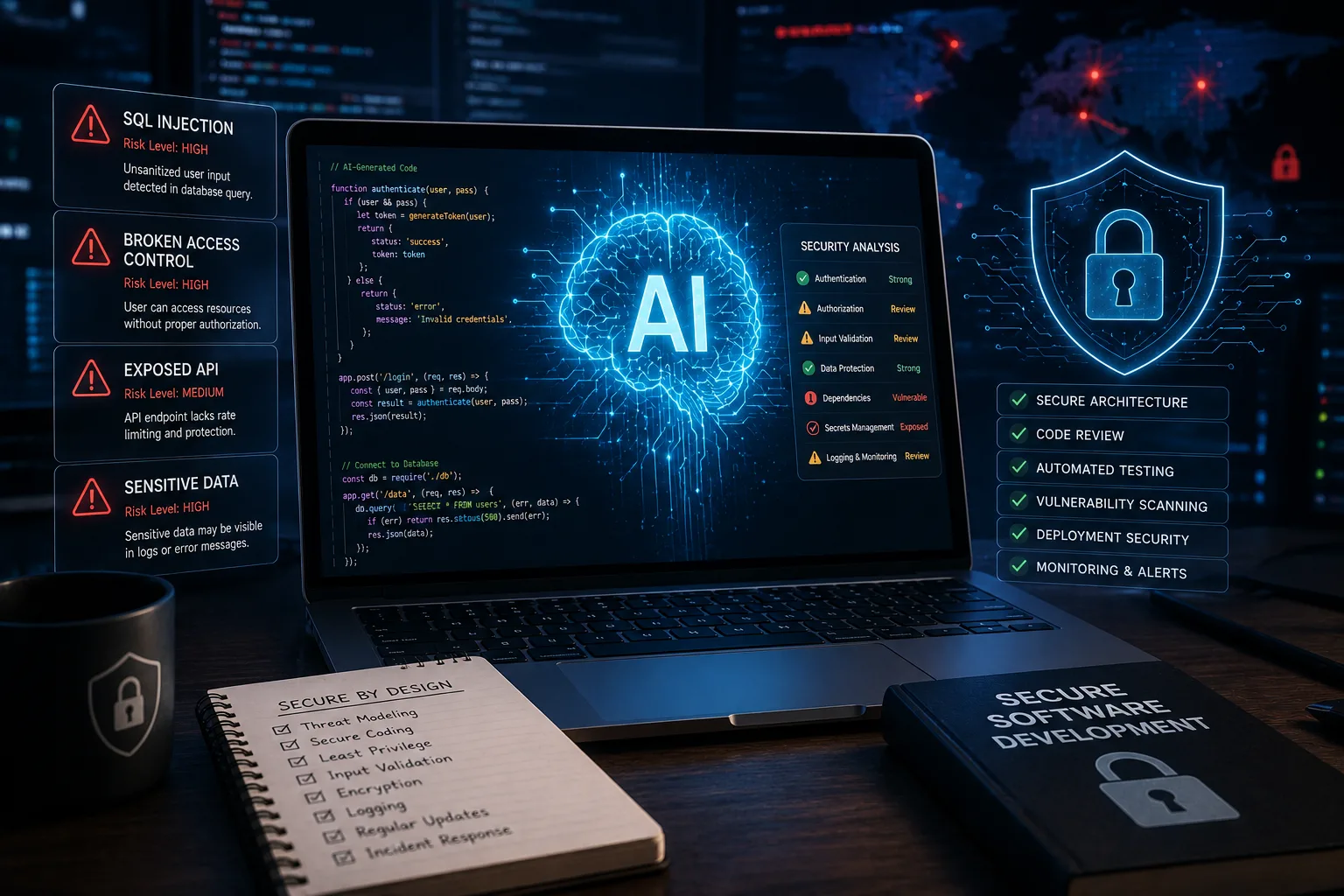
This democratization is valuable because it allows more people to transform ideas into useful software, but it also creates a new category of risk. Someone who does not understand SQL injection may unknowingly deploy code vulnerable to it. Someone unfamiliar with authorization may implement a login system without realizing that authenticated users can access records belonging to other users. A developer who does not understand server-side validation may trust restrictions enforced only in the browser. An application can therefore appear professional while its creator lacks the knowledge required to recognize fundamental security weaknesses.
The speed of generation makes the problem larger. When development took months, there were natural opportunities for architectural discussions, code review, staging, testing, and security assessment. When an application can move from idea to deployment in days—or even hours—the temptation to skip those processes becomes much stronger. AI has accelerated production, but attackers do not care how quickly an application was built. They care about the weaknesses left behind.
Working Code Is Not the Same as Secure Code
One of the most dangerous misconceptions in AI-assisted development is assuming that functional output indicates technical correctness. Software can perform exactly as expected while containing serious vulnerabilities. A login page may authenticate legitimate users correctly while lacking rate limiting against automated attacks. An upload form may successfully store images while accepting dangerous file types. An API may return the correct customer record while failing to verify that the requesting user actually owns that record. A password-reset feature may work normally while exposing tokens through logs or predictable URLs.
These weaknesses often remain invisible during ordinary testing because legitimate users do not intentionally attempt to violate the assumptions of the system. Security testing requires adversarial thinking. Instead of asking whether a feature works when used correctly, engineers must ask what happens when inputs are manipulated, requests are repeated thousands of times, identifiers are changed manually, permissions are bypassed, files are disguised, tokens are stolen, or requests are sent outside the expected interface.
AI models are usually optimized to satisfy the requested task. If a developer asks for an upload feature, the immediate objective is to create an upload feature. Unless security requirements are explicitly included or strongly represented in the development environment, the generated implementation may focus primarily on successful functionality. The same applies to authentication, APIs, forms, webhooks, administrative tools, and database operations.
Professional engineering therefore requires a different standard for generated software. Code should not be considered complete when it merely produces the desired output. It should be considered incomplete until its trust boundaries, permissions, input handling, failure conditions, sensitive data, dependencies, and attack surfaces have been examined.
AI Can Reproduce Vulnerable Patterns as Easily as Good Ones
Generative models learn patterns from enormous collections of software, documentation, discussions, examples, and other technical material. That gives them remarkable programming capability, but the historical software ecosystem contains both excellent engineering and insecure code. Public repositories include outdated approaches, abandoned packages, temporary examples, insecure tutorials, deprecated APIs, and implementations designed to demonstrate a concept rather than survive on the public internet.
An AI model may therefore generate code that looks completely reasonable while reproducing assumptions that are no longer considered safe. The risk becomes greater when developers accept generated code without understanding why a particular implementation was chosen. A human engineer may recognize that an example uses an outdated authentication technique or an unsafe database query. A less experienced user may see only that the code works.
Context can also influence security quality dramatically. If an AI system does not understand the architecture of the existing application, it may create a second authentication mechanism, bypass established service layers, duplicate validation logic, or introduce a dependency that conflicts with existing security controls. Individual pieces of generated code can appear correct while weakening the system as a whole.
This is why repository-aware AI tools are potentially safer than isolated code generation, but even complete repository access does not eliminate the need for human review. Understanding files is not the same as understanding the organization’s threat model, compliance obligations, deployment infrastructure, or business consequences of a security failure.
Authentication Is Only the Beginning; Authorization Is Often the Real Danger
Developers frequently think about application security primarily in terms of authentication: users must have passwords, sessions must exist, and administrators must log in. Authentication is important, but authorization is often more difficult and more dangerous. Authentication answers the question, “Who are you?” Authorization answers the question, “What are you allowed to do?”
An AI-generated application may correctly determine that a user is logged in while failing to verify whether that user is allowed to access a particular resource. Imagine an application where customer invoices are retrieved through a URL containing an invoice identifier. The interface displays only the current user’s invoices, so everything appears correct. If the server simply retrieves whichever invoice identifier is supplied without verifying ownership, an authenticated customer may be able to modify the identifier manually and view another customer’s invoice.
Similar problems can appear in project-management systems, healthcare applications, administrative dashboards, e-commerce platforms, file repositories, subscription services, and internal corporate tools. Every action involving data should be evaluated according to both identity and permission. The fact that an AI system generated authentication does not mean it implemented a complete authorization model.
This becomes especially important as AI itself receives operational permissions. If an AI agent can publish content, modify users, manage orders, or change configurations, its actions must be restricted by the authority of the person operating it. An assistant used by an editor should not suddenly acquire administrator privileges simply because performing an administrative action would satisfy a request.
Database Security Cannot Be Delegated to Convenience
Databases contain some of the most valuable information in digital systems, including user accounts, customer records, transactions, private messages, business information, API credentials, and operational data. AI-generated applications frequently interact with databases early in development because persistent data is fundamental to most useful products. This makes database security one of the first areas where inexperienced AI-assisted development can create serious consequences.
Modern frameworks and object-relational mapping systems reduce many traditional risks when used correctly, but unsafe query construction, insufficient validation, excessive database privileges, exposed credentials, insecure backups, and weak access controls remain possible. Developers must also consider what information is stored at all. Collecting unnecessary sensitive data increases the impact of a breach without necessarily creating additional business value.
AI can help generate migrations, models, queries, and relationships extremely quickly, but the database architecture should still follow the principle of least privilege. Application credentials should have only the permissions required for the application to operate. Secrets should never be committed directly into source code. Production databases should not be casually exposed to the public internet, and backups must be protected with the same seriousness as the primary database.
The most important question is not whether AI can build a database layer. It clearly can. The question is whether the person deploying that database understands what information becomes exposed if one assumption in the generated architecture fails.
Input Validation Remains One of the Most Important Security Boundaries
Every piece of information arriving from outside an application should be treated as potentially hostile. Forms, URLs, HTTP headers, cookies, uploaded files, API requests, webhook payloads, search parameters, and even data received from trusted integrations can be manipulated. This principle existed long before generative AI and remains fundamental in AI-generated systems.
Client-side validation is useful for user experience, but it is not a security boundary. A browser may prevent a user from entering an invalid value through the visible interface, yet an attacker can send requests directly to the server without using that interface at all. Server-side validation must therefore enforce the real rules of the system.
File uploads deserve particular attention. Allowing users to upload profile photographs appears harmless, but a secure implementation must consider file types, MIME verification, file size, filename handling, storage location, execution permissions, metadata, image processing, and potentially malicious payloads. An AI-generated upload component that successfully displays an image after submission may still be unsafe if these issues have not been considered.
The same principle applies everywhere: the expected path through an application is only one possible path. Security engineering is largely the practice of understanding what happens when users do things the developer did not expect.
Dependencies Can Turn Fast AI Development Into a Supply-Chain Problem
Modern software rarely consists entirely of code written by the development team. Applications depend on frameworks, libraries, packages, SDKs, container images, operating-system components, external APIs, and cloud services. AI coding tools can make adding these dependencies almost effortless. A developer can request a feature and watch the system install a package automatically to provide it.
Every dependency, however, becomes part of the application’s supply chain. Vulnerabilities discovered inside a library can affect every application that uses it. Packages can become abandoned, compromised, or incompatible with future security updates. Similar package names can even be used in attempts to trick developers into installing malicious software.
AI-assisted development should therefore include dependency governance. New packages should have a clear reason for existing, be obtained from legitimate sources, and be actively maintained. Security advisories should be monitored, lock files preserved appropriately, and automated dependency scanning integrated into development workflows.
The easiest dependency to secure is often the dependency that was never necessary. AI systems should not automatically solve every minor programming problem by adding another package. Production engineering requires evaluating whether the convenience is worth the additional attack surface and maintenance responsibility.
Secrets and API Keys Are Becoming an Even Larger Target
AI applications frequently interact with external services, which means modern projects may contain credentials for language models, payment processors, email providers, cloud platforms, analytics services, storage systems, databases, and third-party APIs. The more integrations an application contains, the more valuable its secret-management practices become.
API keys should not be embedded directly in client-side code or committed to repositories. Environment configuration, dedicated secret-management systems, restricted permissions, key rotation, and monitoring should be used according to the sensitivity and scale of the application. A leaked credential can create financial consequences even when the website itself is not compromised. Attackers may consume paid AI APIs, send email through trusted infrastructure, access cloud storage, or retrieve private information.
AI development tools also introduce a new consideration: what information developers provide to the model. Copying production configuration, customer records, private keys, database dumps, or sensitive logs into an AI conversation can create a data-governance problem even when the underlying code is secure. Organizations need clear policies defining which information may be shared with external AI services.
Security therefore extends beyond generated code. It includes the entire AI-assisted development workflow.
Prompt Injection Creates a New Category of Application Security
Applications that integrate language models introduce risks that traditional web software did not have to consider. One of the most important is prompt injection, in which untrusted content attempts to manipulate the instructions followed by an AI system. This becomes particularly dangerous when the model can access tools or perform actions.
Imagine an AI assistant that reads documents and can also send email. A malicious document could contain instructions designed to influence the model into exposing information or performing an unintended action. If the AI system treats untrusted document content as instructions rather than data, traditional application permissions alone may not prevent the problem.
The danger increases dramatically with autonomous agents. An AI system that can read databases, modify files, execute code, install software, make purchases, or change user permissions creates a powerful new attack surface. The model should never be treated as a trusted security boundary. Sensitive actions must be validated by deterministic application logic outside the model.
This principle is essential for the next generation of AI software: the model can propose an action, but the application must decide whether that action is permitted. Natural-language reasoning should not replace authorization.
AI-Generated Applications Need Security by Design, Not Security at the End
One of the oldest mistakes in software development is postponing security until an application is almost finished. Teams build functionality first and then conduct a security review shortly before launch. This approach is already inefficient in traditional development and becomes even more problematic when AI can generate features at enormous speed.
Security requirements should exist from the beginning of an AI-assisted project. Authentication architecture, authorization policies, data classification, secret management, logging, dependency controls, backup strategy, rate limiting, input validation, and deployment boundaries should be defined alongside functional requirements. AI should receive these constraints when generating implementations.
This changes prompting itself. Instead of asking an AI coding system simply to “build a customer portal,” professional instructions should specify security expectations. The system should know that authorization must be enforced server-side, sensitive actions require appropriate permissions, user inputs must be validated, secrets must remain outside source control, database queries must use safe framework mechanisms, security-relevant events must be logged, and tests must cover permission boundaries.
Security becomes part of the definition of done rather than an optional improvement.
Automated Testing Must Grow as Fast as Automated Coding
If AI can generate code at machine speed while testing remains primarily manual, the amount of unverified software will grow rapidly. The logical response is to use automation on both sides of the equation. AI-assisted development should be accompanied by automated unit tests, integration tests, authorization tests, API tests, static analysis, dependency scanning, and appropriate security testing.
Tests are particularly important because future AI modifications can unintentionally break assumptions established earlier in the project. An instruction to modify one feature may affect shared middleware, permissions, database relationships, or reusable components. A strong test suite creates boundaries that allow rapid development without requiring humans to rediscover every previous requirement after each change.
Security tests should explicitly verify forbidden behavior, not only successful behavior. Testing that an administrator can delete a record is incomplete; the suite should also verify that ordinary users cannot. Testing that an authenticated customer can access their invoice should be accompanied by a test proving that they cannot access someone else’s invoice. Negative tests often represent the actual security contract of the application.
The future of AI development should therefore not be described simply as automated coding. Mature AI engineering requires automated verification.
Human Review Becomes More Valuable When AI Produces More Code
It may seem contradictory, but the better AI becomes at generating software, the more important high-quality human review becomes. When developers manually wrote most code, they naturally spent time thinking about individual implementation decisions. AI can produce large changes so quickly that reviewing every line with equal attention becomes difficult.
Human review must therefore become more strategic. Engineers should focus on architecture, trust boundaries, data flow, authorization, external integrations, sensitive operations, dependencies, and unexpected changes. They should understand why the generated implementation works rather than approving it because the interface appears correct.
Organizations may also need stronger rules around which AI-generated changes can be merged automatically. A typography adjustment and a modification to authentication middleware should not have the same approval requirements. Changes affecting payments, permissions, encryption, personal data, infrastructure, or security controls deserve additional scrutiny.
AI can serve as a reviewer as well as a generator, and using separate models or review passes can help identify weaknesses. However, asking one AI system to validate another does not remove human responsibility. Models can miss the same classes of problems or confidently approve unsafe assumptions.
AI Can Also Become One of the Most Powerful Security Tools
The security risks of AI-generated software should not obscure the fact that artificial intelligence can significantly improve cybersecurity. AI systems can analyze source code, explain vulnerabilities, inspect logs, identify suspicious behavior, compare configurations against best practices, generate security tests, classify alerts, and help developers understand unfamiliar parts of an application.
For smaller teams, this capability can provide access to security knowledge that previously required specialized expertise. An AI assistant can remind developers to implement rate limiting, identify missing authorization checks, detect exposed credentials, or explain why a dependency warning matters. Used correctly, AI can make secure development practices more accessible rather than less accessible.
The key difference is whether AI is treated as an unquestioned authority or as an additional analytical tool. Security requires layers. AI review can be one layer alongside framework protections, automated testing, static analysis, dependency monitoring, penetration testing, code review, infrastructure controls, backups, logging, and incident response.
The goal should not be to build software without humans. The goal should be to combine machine speed with engineering discipline.
Security Will Separate AI Prototypes From AI-Built Commercial Products
AI has made prototypes extraordinarily easy to create. A working interface can be generated in hours, connected to a database, deployed to a cloud service, and demonstrated to customers almost immediately. This is valuable for experimentation, but the path from prototype to commercial product remains substantial.
Commercial software must survive hostile traffic, unexpected inputs, changing dependencies, infrastructure failures, account abuse, user mistakes, updates, and years of maintenance. It must protect customer information, maintain backups, record important events, enforce permissions consistently, and recover when something goes wrong. None of these requirements disappear because AI generated the original application.
This distinction will become increasingly important as businesses purchase or deploy AI-generated systems. Visual polish can no longer be treated as evidence of engineering maturity. Buyers and decision-makers should ask how the application handles authentication, permissions, backups, dependencies, logging, updates, vulnerability management, data retention, and incident response.
The easiest part of software development is increasingly becoming the part users can see. The difficult part remains everything required to trust it.
Conclusion: AI Makes Secure Engineering More Important, Not Less
Artificial intelligence is changing software development permanently. It allows experienced engineers to work faster, enables smaller teams to build more ambitious products, and gives people without traditional programming backgrounds access to capabilities that were once extremely difficult to obtain. These changes can produce enormous economic and creative value, but they also make it possible to generate insecure software at unprecedented speed.
The fundamental mistake is assuming that because AI can write code, it also assumes responsibility for the consequences of that code. It does not. Responsibility remains with the people and organizations that deploy the system. Authentication must be reviewed, authorization enforced, data protected, inputs validated, dependencies monitored, credentials secured, AI agents constrained, and critical behavior tested regardless of who—or what—wrote the implementation.
Security must therefore become a foundational requirement of AI-assisted development rather than a final inspection performed before deployment. Every generated feature should be evaluated not only according to what it allows legitimate users to do but also according to what it might allow an attacker to do. Every autonomous capability should have explicit boundaries. Every sensitive operation should have deterministic authorization outside the AI model, and every production system should be designed under the assumption that unexpected behavior will eventually occur.
AI can dramatically reduce the cost of producing software, but it cannot reduce the consequences of insecure software. A database breach remains a database breach. A stolen credential remains valuable to an attacker. An authorization failure can still expose private information, and a compromised dependency can still affect thousands of users. Faster development does not make these consequences smaller; without adequate controls, it simply allows vulnerabilities to reach production faster.
The next generation of successful AI-built products will therefore not be defined only by how quickly they were created or how impressive their interfaces appear. They will be defined by whether organizations can combine the extraordinary productivity of artificial intelligence with the disciplines that reliable software engineering has developed over decades.
AI can generate the code. It can assist with testing. It can search for vulnerabilities and recommend solutions. It can even help monitor the finished application. But security cannot become an assumption delegated to a model.
It must remain an architecture, a process, and a responsibility.
Also credited